Dates: 05/09/2025 - 30/11/2025
Address: 9 Usacheva St., Moscow
The project «Off the Grid» by Ilya Gaponov and Stas Bags shifts focus from nature as we know it to its fragmented, impersonal traces—images that speak of loss and transformation. Here, the landscape becomes more than scenery; it turns into a way of thinking, a means of engaging with time and its visual remnants.
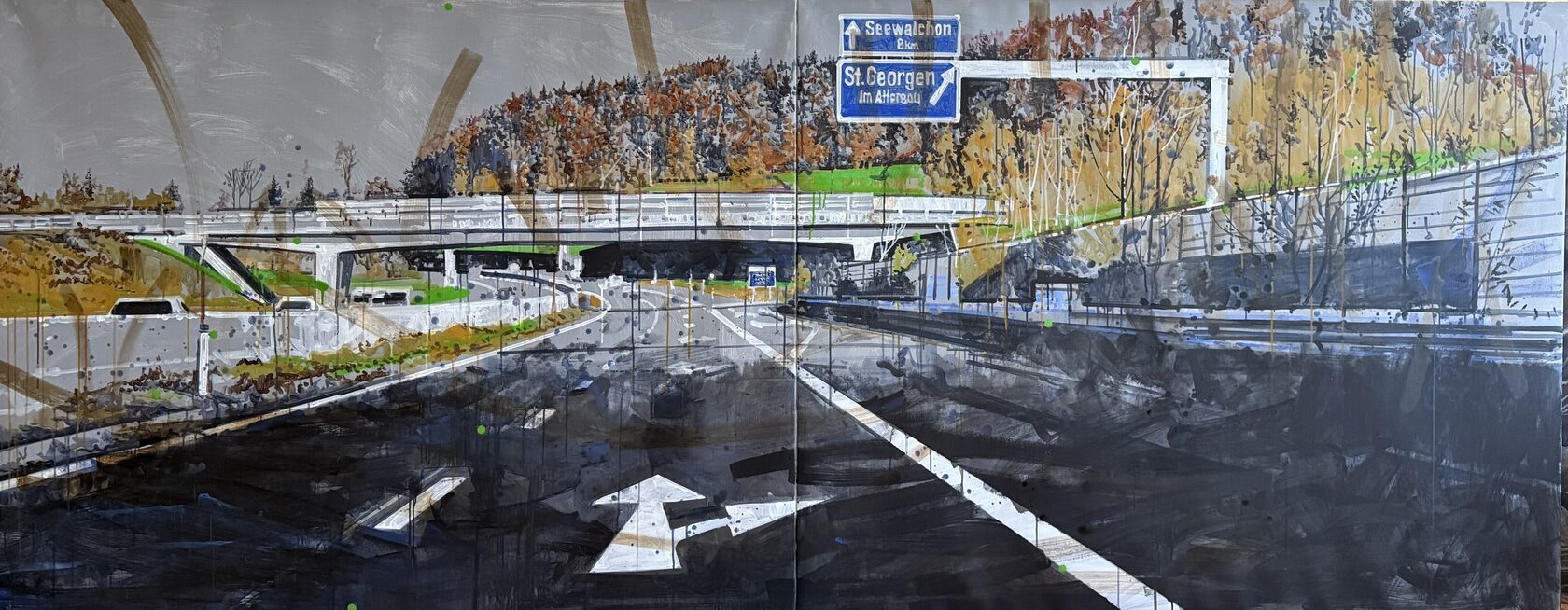
Ilya Gaponov captures the physical imprints of time: rust, road signs, industrial forms. In his work, nature is rendered as a kind of readable archive. “Distance allows the landscape to become a universal motif—both recognizable and strangely unfamiliar,” the artist observes.
For Stas Bags, landscape acts as a silent witness to what has passed. His paintings featuring swings, trees, vacant spaces—carry a sense of quiet implication. Using a stencil-like aesthetic reminiscent of newsprint and a deliberate blurriness, he encourages viewers to reconstruct collective memory through their own gaze.
What unites both artists is their approach to space as a bearer of hidden knowledge. They treat nature not as a stage for human activity, but as a visual repository where time and place leave their marks. Together, Gaponov and Bags invite us to look closer—to notice what often lingers at the edge of sight.
Ilya Gaponov captures the physical imprints of time: rust, road signs, industrial forms. In his work, nature is rendered as a kind of readable archive. “Distance allows the landscape to become a universal motif—both recognizable and strangely unfamiliar,” the artist observes.
For Stas Bags, landscape acts as a silent witness to what has passed. His paintings featuring swings, trees, vacant spaces—carry a sense of quiet implication. Using a stencil-like aesthetic reminiscent of newsprint and a deliberate blurriness, he encourages viewers to reconstruct collective memory through their own gaze.
What unites both artists is their approach to space as a bearer of hidden knowledge. They treat nature not as a stage for human activity, but as a visual repository where time and place leave their marks. Together, Gaponov and Bags invite us to look closer—to notice what often lingers at the edge of sight.